
- Home
- TopicsTopics
- By LocationBy Location
- Newsletter
- Podcast
- About
- Connect
- Restore Hope

After a season of transition, leaders across White and Woodruff counties gathered with a renewed sense of purpose at the latest 100 Families Alliance meeting. Hosted at Harding University, the meeting focused not only on what has been accomplished, but on a shared vision for the future built on stronger partnerships, deeper community collaboration, and a commitment to ensuring every family can find the support they need.
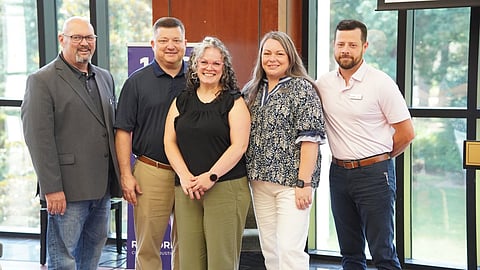
The panel, facilitated by Jeff Piker of Restore Hope, featured Rebecca Davis, 100 Families Coordinator for White and Woodruff Counties, Andrew Baker Director of the Office of Community Connections for Harding University, Blake Schrepfer, Program Director for the Arcare Foundation, and Kayla Burgess, Arcare Community Liaison.
For Andrew Baker, the university's commitment as the backbone organization for the initiative in this region aligns directly with Harding's mission of serving its surrounding community.
"We're a university that believes we have a responsibility to our neighbor, and we have a responsibility to see them as our people."
This partnership also creates new opportunities for students, faculty, and university resources to become more deeply involved in supporting families throughout both counties.
Blake Schrepfer reflected on Arcare's rapid growth over the past several years, noting that despite serving communities across multiple states, the organization's greatest strength remains its local roots.
Because employees live in the same communities they serve, helping families is deeply personal.
"We are of the community... we do better when our community does better."
That philosophy closely mirrors the vision behind the 100 Families Initiative—bringing organizations together so families experience coordinated support instead of navigating complex systems alone.
Kayla Burgess emphasized that no single organization can meet every need facing local families.
"It takes everybody in this room to meet all the needs of this community. It can't take just one organization, one nonprofit."
Since becoming coordinator earlier this year, Rebecca Davis has helped guide the initiative through an important transition. While the alliance no longer operates from one centralized resource center, Davis explained that the strategy remains.
Instead of requiring families to find one physical location, the initiative fosters a community-wide network where every partner knows how to connect families with the right resources.
"We want to create... a network to where our families see no wrong door."
Whether someone enters through a school, healthcare provider, nonprofit, church, law enforcement agency, or another community partner, they should be able to access the help they need without starting over.
Davis noted that through this the model, the outcomes have remained strong.
Families are being served, advocates remain active throughout the counties, and community partners continue working together to help families move toward stability.
Looking ahead, panelists expressed optimism about the future.
Schrepfer pointed to growing collaboration around reentry services for individuals returning from incarceration, highlighting the importance of continuing to strengthen pathways that reduce recidivism and connect people with housing, employment, behavioral health, and other supports.
Rebecca Davis acknowledged that White County often appears near the top of state statistics for poverty, incarceration, and other challenges. Yet she believes those same realities have also produced one of the region's greatest strengths: a community full of people willing to help.
"There is the greatest need, but there's also such a great community of helpers here. So it's really a unique and beautiful opportunity to really do something really big and impactful."
Baker closed by placing White and Woodruff Counties' work into a much larger conversation.
Drawing from recent discussions with international leaders studying community flourishing, he explained that communities thrive not because one organization has every answer, but because people choose to work together.
"We're not working in silos. Nobody's got it all figured out. Nobody's got all the answers."
He encouraged attendees to recognize how much progress has already been made over the past decade.
"The net got stronger in White County... those who are genuinely wanting to take the next right step, I would say it's easier for that to happen today than it has been before."
While much work remains, Baker believes the community now has a stronger foundation than ever before.
With Harding University serving as backbone, Arcare continuing its deep community investment, Rebecca Davis leading local coordination, and partners across both counties working together, the alliance enters its next chapter focused on creating a community where every family can find support, every organization has a role to play, and there is truly no wrong door.
Smart Justice is a magazine, podcast, and continuing news coverage from the nonprofit Restore Hope and covers the pursuit of better outcomes on justice system-related issues, such as child welfare, incarceration, and juvenile justice. Our coverage is solutions-oriented, focusing on the innovative ways in which communities are solving issues and the lessons that have been learned as a result of successes and challenges.
The podcast is available on all major podcasting platforms.
Subscribe to the Smart Justice newsletter.
