
- Home
- TopicsTopics
- By LocationBy Location
- Newsletter
- Podcast
- About
- Connect
- Restore Hope

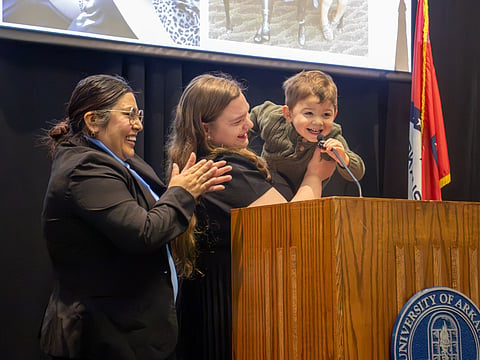
There was cause for celebration at the University of Arkansas–Fort Smith as community partners gathered to recognize the achievements of the 100 Families Initiative and its expansion into the 10:33 Initiative. Through this community-led effort, 633 individuals in Sebastian and Crawford counties have moved out of crisis and onto a path toward long-term stability and a sustainable career. Now, the expansion will open the door to serve more people and connect them with a broader network of support.
Mark Allen, who was involved in the initiative's earliest efforts, reflected on the progress made possible by the community's commitment to one another.
"I applaud you so much for the strides you've made...to look after each other and take care of one another."
The 100 Families Initiative began in Crawford and Sebastian counties to help families navigate a historically fragmented network of services. Its collaborative case management model brings existing providers together through HopeHub, reducing duplication, improving communication and giving participants a coordinated team to help them achieve their goals.
Law enforcement was among the earliest partners to embrace this approach. Under the leadership of Fort Smith Police Chief Danny Baker, the police department began using HopeHub to connect individuals with services as alternatives to arrest when appropriate, helping address underlying needs before they escalated into further crises.
Recognized during the event ahead of his upcoming retirement, Baker reflected on the transformation.
"Over the last 8 years together, we've worked to instill the principles of 100 Families into the mindset and culture of not just our community, but our police department."
He credited the approach with helping reduce incarceration through diversion to restorative services and supporting thousands of children and families.
"I believe that we have proven there is a better way, a more impactful way to improve the lives of everyone in our community."
As more sectors joined the effort, the University of Arkansas–Fort Smith became the backbone organization for the Sebastian County Alliance.
Chancellor Terisa Riley shared that she initially declined the opportunity, questioning whether it aligned with the university's mission. After reflecting on UAFS's commitment to social mobility and economic development throughout the River Valley, however, she recognized how naturally the work fit.
"How in the world can you say this isn't a perfect fit? How in the world could you think that this isn't part of our mission, to connect these amazing people and resources across the River Valley...So it's a yes again and again and again to being that platform, for being a connecting hub, for ensuring that every member of our community is respected and valued and cared for in such remarkable ways."
Today, each participant's support team includes an average of 13 individuals representing six organizations.
Crawford County Coordinator Becky Petty highlighted the initiative's leading referral sources: self-referrals, community partners and friends, the Division of Children and Family Services (DCFS), and adult education centers.
"Self-referral is the top referrals source right now and I think that's incredible because it means that the community knows. They know where to go to get help."
Sebastian County Coordinator Courtnee Harlan emphasized the vital role of DCFS in connecting families to resources during investigations, supportive service cases, protective service cases and foster care involvement. Over the past year, DCFS staff participated on 127 support teams in the two counties.
Arkansas DCFS Director Tiffany Wright recalled the challenges she faced as a frontline caseworker before this coordinated approach was available.
"I think decisions I would have made as a frontline caseworker would have been different because I wouldn't have been alone."
She described how the partnership has transformed the agency's ability to serve families.
"We're preventing foster care when it's appropriate, and we're leaning heavily into the experts in the community and doing it together, and that's what you see here today."
Sebastian County has experienced a 49% reduction in children in foster care between fiscal years 2017 and 2025, declining from 1,093 to 561.
The faith community has also played a significant role in these outcomes. Matt Whitson, co-founder and executive director of Arkansas Family Alliance, explained how CarePortal connects churches with needs identified by family advocates, child welfare workers and other community providers. Churches can then respond with practical assistance while building relationships with families.
"This is a lot of churches doing a little. And when a lot of churches do a little, we do a lot."
In 2026, eight active churches in Crawford County helped serve 344 children through CarePortal, representing an economic impact of more than $302,000. In Sebastian County, 22 active churches helped serve 595 children, with an economic impact exceeding $264,000.
The benefits extend beyond meeting immediate needs. Data presented at the event showed that the reunification rate among families served by the community alliances was approximately 72.5%. Among cases where CarePortal and the alliances served the same families in a coordinated way, that rate reached approximately 90%.
The stories of two mothers, Alexis Williams and Lilly Ann Reed, offered a glimpse into the lives behind these collective outcomes.
In Crawford County, Alexis, a single mother of four, overcame housing instability with help from community partners who provided housing connections, necessities for her daughters and ongoing encouragement. Today, she gives back by volunteering with one of the organizations that once supported her.
In Sebastian County, Lilly overcame homelessness, substance use challenges and incarceration while working to reunite with her young son. With assistance from treatment providers, DCFS, churches and community organizations, she achieved recovery, stable housing, employment and ultimately reunification.
"Knowing someone's there," Alexis shared, "and knowing that so many people are there for me and my babies is the most reassuring thing."
These stories reflect the possibilities created by 100 Families, but the initiative's original eligibility requirements limited participation to individuals with children in their care. Someone like Chris Pacheco, a young man facing significant challenges after a life-changing mistake, would not have qualified.
Governor Sarah Huckabee Sanders' 10:33 Initiative changed that.
Family advocate Patrick Myers shared the extraordinary circumstances that brought Chris into his life. In 2025, Patrick's son was seriously injured in a crash involving Chris, who had been driving under the influence.
Initially, Patrick wanted Chris to serve prison time. But drawing on his own experiences and faith, he began to see an opportunity for forgiveness and a different future for the young man.
Patrick and his wife, Amanda, asked the prosecuting attorney to support a sentence without prison time. Chris returned home to his family and began building relationships with people who offered mentorship, accountability and encouragement.
When 10:33 expanded eligibility beyond the original 100 Families model, Patrick enrolled Chris as his first participant.
Through the initiative, Rebecca Cobb with Chance for Change helped Chris secure employment at Eversource, where he has since earned multiple promotions. Additional connections helped him find a path back to higher education, with plans to begin college in the spring.
Restore Hope Chief Operating Officer Karen Phillips explained that the expansion creates opportunities to help "more people in more ways than ever before, through government, church, and nonprofit partnership."
Melody Pettit, representing the Arkansas Department of Education and the Governor's Faith-Based Initiative, emphasized that 10:33 is rooted in the collective responsibility of the entire community.
"It's not about one organization. It's not about the state coming in and making all of the changes, all the differences. It's about the community."
A central principle of the initiative is "no wrong door," meaning individuals can connect with services through multiple entry points, whether they seek help from a government agency, church or community organization.
Restore Hope Executive Director Paul Chapman explained the vision:
"The vision of 10:33 is that if someone walks into a church or to a WIC office or to a child welfare office and they disclose that they're in a complex situation, they need help, then finding that help should not be the hard part of the situation."
Looking ahead, plans include expanding coordinated services for individuals reentering communities from prison, improving access to information across participating agencies with participant consent, and connecting more schools, courts, health providers and community organizations to the network.
As the River Valley celebrates the achievements of 100 Families and embraces the possibilities of 10:33, the mission remains the same: helping people overcome crisis and build lasting stability through the collective strength of their community.
Smart Justice is a magazine, podcast, and continuing news coverage from the nonprofit Restore Hope and covers the pursuit of better outcomes on justice system-related issues, such as child welfare, incarceration, and juvenile justice. Our coverage is solutions-oriented, focusing on the innovative ways in which communities are solving issues and the lessons that have been learned as a result of successes and challenges.
The podcast is available on all major podcasting platforms.
Subscribe to the Smart Justice newsletter.