
- Home
- TopicsTopics
- By LocationBy Location
- Newsletter
- Podcast
- About
- Connect
- Restore Hope

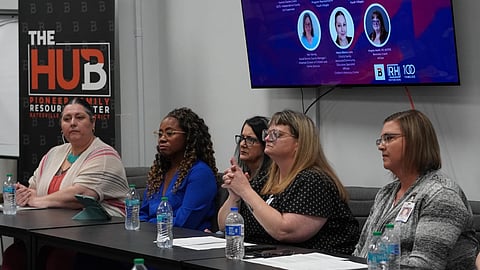
In Independence County, Arkansas professionals working in child welfare and behavioral health came together for a candid community conversation about the realities behind child abuse and neglect — and what it takes to prevent it.
The panel highlighted a consistent message: child maltreatment is rarely caused by a single issue. Instead, it is often connected to larger challenges such as addiction, untreated mental health concerns, generational trauma, housing instability, and lack of access to support systems.
According to DCFS, Independence County received 396 child abuse hotline reports in 2025 alone. Of those, 268 were accepted for investigation or response services.
Panelists explained that accepted reports may lead either to formal investigations or to “differential response” services — a lower-risk intervention focused on stabilizing families and connecting them with support before conditions worsen. The discussion also emphasized that many cases involve patterns that repeat across generations.
“Most abuse and neglect is generational,” one DCFS representative said. “If you are a victim of abuse or neglect as a child, you are more than likely going to be an offender later in life because that’s the only life you know.”
Behavioral health professionals on the panel described substance use disorder as a major contributor to family instability and child welfare involvement.
"When somebody is in addiction or substance use, everything shifts. The focus is the addiction. People are not able to be responsive and attentive to their families and their needs because all that matters is the next use," said Megan Milsap of ARCare, a nonprofit community health center network that provides medical, dental, behavioral health, pharmacy, and preventive healthcare services across Arkansas.
"When we're in addiction or substance use, everything is affected by that: our financial stability, our housing stability. People in this situation are living in chaos and so are their families."
Panelists also emphasized that substance use and mental health challenges often occur together.
“It’s going to be very rare to find somebody with substance use issues that does not have a co-occurring mental health issue,” said Milsap.
The conversation highlighted serious service gaps in Arkansas, particularly for youth substance abuse treatment.
"There's no drug treatment for juveniles in Arkansas. As we know from the data, most abuse and neglect is generational. That even includes the drug abuse," said Keri Worley, Social Services County Manager for the Arkansas Division of Children and Family Services.
"You would be surprised at the number of kids in our community who start using illegal substances under the age of 10 years old. So if they're not able to get any quality treatment, then it's just going to continue. It's a cycle."
Another challenge discussed was the difficult choice many parents face when seeking treatment.
“A lot of times parents — moms particularly — are faced with, ‘If I go to rehab, what happens to my child?’,” noted panel moderator Jennifer Worthington of the Batesville School District, who works with families in crisis.
Panelists noted that there is a rehab facility in Arkansas that currently allows mothers to bring children with them during treatment.
The panel also focused on early warning signs of abuse and neglect.
Professionals encouraged community members to pay attention to behavioral changes in children, excessive absences from school, visible injuries, withdrawal, untreated medical needs, or signs that children are not receiving adequate care.
"I think it's making sure that a person is just really looking at the child's behaviors. If the child is acting differently or the child appears to be sleepy during class, or if they're not getting their medications," said Yvonne Charles Cusick, the Independence County Unit Supervisor for the Department of Children and Family Services.
Maria Blanco-Lora of Children’s Advocacy Center emphasized the importance of safe, child-friendly environments where children feel comfortable disclosing abuse.
“We hate for our children to be interviewed at a school office or a police station,” she explained, describing how advocacy centers create calmer settings designed specifically for children.
The forensic interview process is intentionally designed to reduce additional trauma by allowing children to tell their story one time rather than repeating it to multiple agencies.
Throughout the discussion, collaboration repeatedly emerged as one of the most important tools in child abuse prevention.
Courtney Ridings and Anita Daniel's of Youth Villages described how their organization works alongside DCFS, schools, behavioral health providers, courts, and advocacy centers to stabilize families during crisis situations.
The organization provides intensive in-home services focused on safety, structure, and long-term stability. That can include helping families develop routines, create de-escalation plans, secure safe housing, or learn parenting skills that may never have been modeled for them growing up.
Panelists stressed that many parents involved in the system are not unwilling to care for their children — they are often overwhelmed, isolated, or repeating patterns they experienced themselves.
One of the strongest themes of the discussion was the need to reduce stigma around seeking help. Panelists encouraged community members to approach struggling families with compassion rather than judgment.
“Sometimes just giving the information is more helpful and useful than anything else,” said Ridings.
Another emphasized that simply listening to families can make a meaningful difference.
“Sometimes they just need someone to hear them out,” a panelist said. “They may already have the tools to handle it themselves. They’re just so elevated and escalated in that moment.”
The panel closed with a reminder that protecting children is not solely the responsibility of one agency or organization. It requires communities willing to work together, support families early, and create environments where asking for help is seen as a strength rather than a failure.
Smart Justice is a magazine, podcast, and continuing news coverage from the nonprofit Restore Hope and covers the pursuit of better outcomes on justice system-related issues, such as child welfare, incarceration, and juvenile justice. Our coverage is solutions-oriented, focusing on the innovative ways in which communities are solving issues and the lessons that have been learned as a result of successes and challenges.
The podcast is available on all major podcasting platforms.
Subscribe to the Smart Justice newsletter.
