
- Home
- TopicsTopics
- By LocationBy Location
- Newsletter
- Podcast
- About
- Connect
- Restore Hope

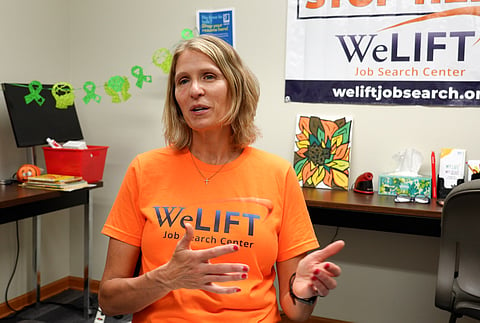
INDIANOLA – In a small white building near the corner of highways 65 and 92 in Indianola big work is being done. It's exhaustive work and at the center of it is one selfless woman dedicated to serve her community.
Sue Wilson is the director of WeLIFT, a nonprofit organization serving the people of Warren County who are in need of resources, employment, education or self-sufficiency. The goal is to provide them with the tools to put them on the path of independence. Independence is the key word in WeLIFT's acronym.
"It stands for We Learn Independence For Tomorrow," Wilson said recently during an interview with Thrive Iowa.
Wilson's journey to the nonprofit sector began more than a decade ago, when she was volunteering at a local food and clothing pantry. It became clear to her then that there was trouble in the foundation of how people in need were being served in the community.
"I quickly became aware that we can't just continue to hand things out to people," Wilson said.
She looked further into how the people she was serving, many of which were suffering with some type of neurological trauma, could be better off with something more than just a regular handout.
She wanted to help them become self-reliable.
In 2022, following an exhaustive year of helping the in-need community of Warren County through the COVID-19 pandemic, Wilson took the job at WeLIFT and had a vision of how to better provide for the people of Warren County, especially those in the rural communities.
Among her objectives was to create a community hub where state, local, and faith-based nonprofits could come together to help WeLIFT's clients. The resource navigation system helps guide clients to the areas they need help in.
"I learn so much every single day. I've learned what it is to give grace and be given grace."
Sue Wilson, Director of WeLIFT
It operates much like what the Thrive Iowa initiative is doing in cities and communities throughout the state. By targeting key areas of crisis it eliminates the cumbersome and oftentimes intimidating process clients feel when applying for help.
"It could be housing applications, SNAP applications, setting up mental health appointments," Wilson said.
In her time at WeLIFT Wilson has seen many areas of need arise, but one constant trouble spot has been affordable housing.
"Affordable housing is a huge issue right now. When you do a housing study and we find out that 38 percent of our community are 30 percent cost-burden as renters, that's saying of the almost 40 percent of our community that pays rent, 30 percent of their paycheck has to go to that. That doesn't leave a lot (of money) for other things."
Food insecurity and employment are also issues that clients are consistently seeking help with.
Wilson says outside the Indianola Community School District, the largest employer in Warren County, there are simply not enough full-time job opportunities that come with insurance benefits for job seekers. The concern is that these issues will continue to have a cascading effect.
While often city leadership is an easy target to look to when casting blame, Wilson says city leaders simply don't know what they don't know. She feels a united front between the city and local nonprofits is necessary to begin to curb some of Warren County's sticky issues.
"Everyone has to know where their space is," Wilson said, adding that finding the people you need to find shouldn't have to result in frustrating abandon.
"At the end of the day, people just need more assistance," Wilson said.
Wilson, a mother of two teenage daughters, says she is constantly humbled that she's been called upon to serve in her line of work.
"I learn so much every single day. I've learned what it is to give grace and be given grace."
The stories of hardship and heartbreak come fast in Wilson's field.
"A lot of people like to say that everyone is one paycheck away (from losing everything), but that's not true because many people have support systems. Some people have zero. I have options if I need. But there's people that don't have options. They can't move in with loved ones. They might not be able to get the cancer treatments they deserve because their insurance doesn't cover it. They might not get their mental health medications. They may not be able to be reunited with their mom."
Wilson, not ashamed to succumb to her emotions – after all this work tends to be very emotional – pauses to process the realities faced by the countless human beings whose stories took an unfortunate turn. With glassy eyes she looks back into the camera and resumes the interview.
"That's heartbreaking for us to know."
Wilson said the staff of five at WeLIFT are a small but mighty team of helpers.
"A lot of what we believe here at WeLIFT is you don't have to know someone's story to show them compassion. It's just being a good human."
Wilson's love language is serving others, but she'll be the first to admit that compassion fatigue is real and burnout can be difficult to overcome. Both were lessons she learned the hard way, and almost at a significant cost. Her demanding work schedule left little time for anything else and, unbeknownst to her at the time, an invisible wedge was pushing its way between Wilson and her family.
The wedge was her career, and her unrelenting desire to help others.
"I used to think I was Superwoman," Wilson said. "I used to think that I could have a heavy day (at work) and that I could still go home at the end of it all."
While she was feeling like a superhero in her workspace, at home she'd begun to feel more like the villain. Following those emotionally heavy days of helping her community, a simple roll of the eyes from either of her teenage daughters could send her mood spiraling.
"I became not the person I wanted to be," Wilson said. "I had to learn how to de-escalate."
Wilson said that WeLIFT now offers de-escalation training as a result of her experience. It's something she remains proud of and passionate about.
"I was in the middle of a lifestyle that I was going to lose my children and husband if I didn't figure it out. And that's what de-escalation is. It's about you. It's about how you handle situations."
Wilson said the pivotal point came one day when her daughter made a comment that stopped her in her tracks.
"When my daughter said to me, 'mom, you're here but you're not really here,' that said a lot," Wilson said. "I had to take a real hard look at how do I want my girls to be raised."
She sought the advice of her closest friends and her pastor and soon after established some boundaries. She began doing for herself what she'd spent her entire career helping others with: being her own best advocate.
Wilson's faith is sacred to her. She feels God chose her for this line of work.
"I believe He knows it's going to be hard, but I rely on Him to get me through it," Wilson said.
While God may have selected Wilson for this occupation, her pastor is there to remind her from time to time that she's not Jesus. Her pastor is someone she looks up to and often seeks for guidance and advice.
She recalled him tell her once not that long ago that she alone can't solve everyone's problems.
"He said to me, 'you're not Jesus. You can't do it all. And he doesn't want you to do it all.'"
Keeping those boundaries have paid off.
Since then she no longer schedules late meetings. She attends her daughter's school events and is home in the evenings to enjoy family time. She keeps a tight "quiet hour" in the house, a time when electronics are powered down and their brains can decompress. She finds that hour to not only be peaceful and restorative, but important to maintain a healthy mind.
"I want to be able to come home and provide (my family) dinner and spend time with them," Wilson said. "That's important to me, and unfortunately it took me a long time to get there."
Her boundaries have also paid off at work.
"When I start to feel like I'm not hearing the clients enough because my brain is going the wrong way, then I know it's time for me to shift or find some time for me," Wilson said.
The job has many success stories to draw from, and Wilson uses some of them when she needs to meet with her business partners to help spread the message that the work they are doing is not unproductive.
Wilson spoke of a young woman who the WeLIFT staff found living in a tent. The woman came to WeLIFT with bug bites up and down her arms and legs, hungry and homeless. She is now thriving, renting a home in a small town outside of Des Moines.
"She works full-time for one of our partner organizations, Wilson said, adding that she's a talented wood crafter who makes amazing benches.
"She's done it all herself," Wilson said. "But the most powerful thing is that she's learned self-advocacy."
Those success stories keep Wilson and her small but mighty team powered as WeLIFT continues to educate and provide for residents of Warren County. The work is hard. The thank-you's are few. The emotions are polarizing and the compassion fatigue is real.
But Wilson's love language is serving others. And she's quite fluent.
"I'm constantly humbled that I get to be in this work."
Smart Justice is a magazine, podcast, and continuing news coverage from the nonprofit Restore Hope and covers the pursuit of better outcomes on justice system-related issues, such as child welfare, incarceration, and juvenile justice. Our coverage is solutions-oriented, focusing on the innovative ways in which communities are solving issues and the lessons that have been learned as a result of successes and challenges.
The podcast is available on all major podcasting platforms.
Subscribe to the Smart Justice newsletter.
