
- Home
- TopicsTopics
- By LocationBy Location
- Newsletter
- Podcast
- About
- Connect
- Restore Hope

WAPELLO – Cindy Mears said that an alarming amount of residents of Louisa County are financially strapped on a day-to-day basis, and finding resources is a burden due to criteria that is often confusing. Mears, general assistance director at Louisa County Community Services, says watching her neighbors go from silo to silo and spin their wheels just to go home with nothing but more questions and frustrations has been difficult for her and other leaders of Louisa County.
"When we operate in silos, damaging things happen," Mears said. "A resident in crisis has to tell their very worst day over and over again to many different agencies."
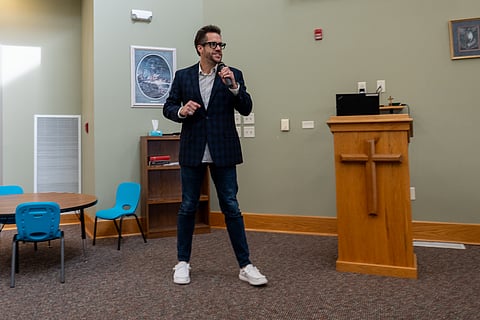
Mears, who spoke at a collective impact meeting in Wapello, is optimistic that things will change with the arrival of the Thrive Iowa initiative, which uses the collective impact model and a system created by the Arkansas nonprofit Restore Hope.
Restore Hope has spent the past decade helping residents in some of the most poverty-stricken counties in the United States make it out of crisis mode.
Representatives from Restore Hope were in multiple Iowa counties recently, along with members of the Iowa Department of Health and Human Services, speaking about the collective impact model and how it will benefit the residents of some of Iowa's own hard-hit areas.
The Thrive Iowa initiative has been operating in multiple counties since the beginning of 2026, and has been growing at a fast rate. This is both testament to the success of collective impact and how many Iowa families need assistance.
The Restore Hope model looks at thirteen care areas and works with organizations within the site counties to bring help to the families where they need it the most.
Paul Chapman, CEO of Restore Hope, often compares collective impact to the construction of a new home. The plumber handles the pipes, the electrician handles the power, the roofers handle the shingles. All this is coordinated by a project manager, who makes sure the work is done in a system that makes sense. When you need the sink installed you don't call the concrete teams. With the Thrive Iowa initiative, those project managers are the coordinators at each site. The site navigators help the families navigate to the resources they need and stay with them along their journey.
All information is confidential and protected by HIPAA, COPAA and FERPA.
In western Iowa, collective impact meetings were held at the new Thrive Iowa sites at Pottawattamie and Woodbury counties.
In Sioux City it was standing-room only for the turnout as more than seventy people arrived to hear from leaders and experts in the field discuss a new way to assist Iowa residents in need of help.
Kevin Grieme, the director of Siouxland District Health Department, said when he thinks of collective impact he feels comforted that the strengths of the communities resources are being utilized properly.
"It's wonderful that we have a lot of options, but what's challenging is sometimes we don't always get them into one place where they can get everything taken care of," Grieme said.
He, like so many community leaders across Iowa, want to see those challenges reduced.
"How do we reduce the amount of chaos that this family home is existing within?"
In Council Bluffs turnout was similar. Michael Arias, the coordinator at Thrive Iowa of Pottawattamie County, said turnout for the collective impact meeting left him optimistic of where the initiative in his county can be a year from now.
"I have high hopes that the collective impact model will help to raise awareness of the vast amount of resources that are available, and improve collaboration and information sharing between those resources," Arias said.
Like many of the counties served by the Thrive Iowa initiative, many households are facing issues that fall within those 13 care areas.
"We have a very high need in our community for many types of assistance, and I believe that this model can help families who are struggling to navigate resources for the different needs that they may have," Arias said.
In Milford, community leaders of Clay and Dickenson counties filled up a church dining hall where local nonprofit consultant Kevin Brown said that it's important to come together for the benefit of their neighbors in need.
"This may be the lowest moment of their life, and they're just trying to get to get out of that moment," Brown said.
The benefits of collective impact have been proven, and are being proven effect in Iowa. Strong communities want to build each other up.
Because as Connie Noreen, director of the Sioux City Dream Center, said: "We love our community and we want to see it thrive."
Smart Justice is a magazine, podcast, and continuing news coverage from the nonprofit Restore Hope and covers the pursuit of better outcomes on justice system-related issues, such as child welfare, incarceration, and juvenile justice. Our coverage is solutions-oriented, focusing on the innovative ways in which communities are solving issues and the lessons that have been learned as a result of successes and challenges.
The podcast is available on all major podcasting platforms.
Subscribe to the Smart Justice newsletter.
