
- Home
- TopicsTopics
- By LocationBy Location
- Newsletter
- Podcast
- About
- Connect
- Restore Hope

The emotional journey of foster care is often pictured as an iceberg. You can see the large, rock-solid obstacle representing foster care, and the visible part in itself is a force to be reckoned with. However, as with an iceberg, the majority of the obstacle is actually below the surface. I first met Manuel Torres of Unspoken in Washington DC at the National Press Club, where he and his team spoke of their recent research in which they attempted to uncover the emotions of fear, regret, insecurity, and embarrassment that live under the surface, and the contributing factors to these emotions that occurred throughout the often long journey of foster care.
From journaling, both in writing and video content, adults with foster care experience were asked to remember and uncover the events before foster care, during foster care, and after they left foster care... either through reunification, adoption/guardianship, or aging out. What was interesting is the pain points along the way, and both the similarity and differences in the journey. While all those who participated in the research had some major similarities in the pain point of removal, for example, others had either points of light or points of distress with their relationship with their caseworker or parent. The people change, those who are positive and negative in their stories greatly differ, but the events are closely comparable... these traumatic occurrences that, with each event, the weight of emotions and hardships they carry hold them back, slow them down, and sometimes become inescapable.
The Final Nail in the Coffin
For many, there is a single moment that they return to... the one that ended life as they knew it. For Dara, who entered care at 17, it was a routine checkup. "I think the final nail in the coffin was that my dad went to take my youngest sibling to the hospital for a checkup. And then the pediatrician noticed that she looked malnourished and stuff like that... he cited that as child neglect. So that was the final nail in the coffin. Until recently, I thought it was all my fault. But, my mom told me that's why the social workers came back." Years later, the weight Dara still carried was not just the removal itself, but the belief that she had caused it. That misunderstanding... never corrected, never explained... became its own enduring trauma.
The Car Ride
If removal is the rupture, the car ride is the freefall. It is the moment a child is handed over to a stranger and asked to trust completely, with almost nothing explained. Valerie, who entered at age 4 across three placements, described "getting into a stranger's van": "I remember seeing her and I didn't know who she was... And the coordinator just being like, no, no, she's here for you. How do you know?... And even as a four year old, it's weird reinforcing the idea that oh yeah, you can get into a stranger's van." Others described the same disorientation as a flood of unanswered questions. As Kate, age 21, recalled being taken without explanation while her younger brother was separated from her: "I'm screaming, going absurd. Where are you taking my little brother? ... I said, this is not OK. This is not fine."
What is striking is how often a small amount of information would have changed everything. In Valerie's words from another moment in the journey: "Any little piece of information would have helped ease the uncertainty." The trauma of the car ride is rarely about the car. It is about being moved through a life-altering event with no one slowing down to say what was happening, where she was going, or who this person was.
Living in a Backpack
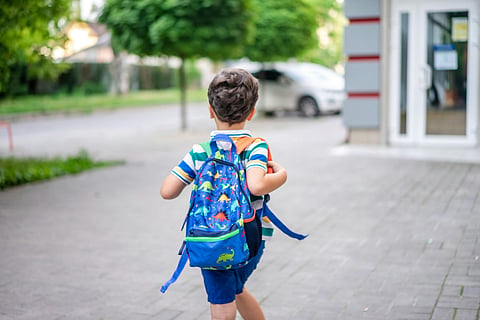
Then comes the impermanence. Placement after placement, the sense that you belong nowhere and to no one. Phoebe, who entered between ages 3 and 4 and experienced four or more placements, put it plainly: "A lot of it is a blur... moving from house to house, having my belongings in a trash bag, being like, okay, this is where you're going to be for a while because the last place got tired of you or couldn't handle you anymore." Ashley, age 21, described it even more starkly: "I essentially lived in a backpack for years of my life." The research participants were clear that decompression and adjustment time between transitions is not a luxury... it is what allows a child to stabilize before being expected to adapt yet again.
Culture Shock
Even a "good" placement can be its own kind of loss. Entering an unfamiliar home, with unfamiliar rules, unfamiliar food, and unfamiliar expectations, can leave a child feeling like a guest in someone else's life rather than a member of a family. And belonging, the research showed, is not automatic just because a placement is stable. Elena, who entered at 15, described being kept invisible: "We could not be posted online on social media. So every family cookout, every family reunion and event, we had such a great time, but we couldn't be in pictures because we have an active CPS case... it made me feel sad that I couldn't be visually a part of the family, like publicly." She was physically included and emotionally fenced out at the same time.
The Caseworker: Enemy or Savior?
Perhaps no relationship in the journey is more pivotal, or more variable, than the one with the caseworker. The same role that can rescue a child can also abandon them, and youth feel both possibilities acutely. Dara captured the ambivalence: "They seemed like both the enemy and the savior... definitely a gray area with them." For some, the absence was the wound. Hannah, age 20, recalled: "My case worker was not participating in my case, which is like literally my life... it was everybody. And I really was there [at the group home] for a lot longer than I needed to be." For others, the caseworker was the point of light. Elena described someone who paid attention: "I think I had a very good caseworker... who knew what they were talking about or knew where they could find someone who knew what they were talking about. And I had a lot of drive to keep pushing back and go, OK, what else can you find for me?"
This is the heart of why this research matters for those of us on the front lines. The difference between "enemy" and "savior" was rarely about heroics. It was about showing up, checking in, and following through. As Ashley reflected on a worker she trusted: "They're not afraid to tell me the truth... I'm glad that my team did that because I realized that I needed to do better." The micro-interventions that changed a trajectory were small, human, and repeatable... a phone call returned, a promise kept, a hard truth delivered with care.
Mediating Interactions with Biological Family
The system's role as gatekeeper to a child's own family showed up again and again as a source of pain. Sarah, who entered at 15, described how communication restrictions deepened her isolation: "They took our phones away for a while, because we were in a small town where my family lived. And they didn't want us to reach out... they didn't want them trying to convince us of anything or talk us into things." Valerie remembered being blocked from a parent who had moved heaven and earth to show up: "I remember seeing my mom outside of the house. And she didn't know how to drive at that time. So she had taken a bunch of buses to get to that house. And then [my foster mom] just didn't allow me to see my mom."Whatever the safety logic behind these decisions, what the youth absorbed was severance... and, often, no explanation for it.
Providing Mental Health Services
Finally, the research surfaced how often the very services meant to help instead taught children not to trust their own inner lives. Nina, who entered at 10 across 10 to 15 placements, felt processed rather than heard: "I kept telling them that the medication wasn't helping in the ways that they thought it was helping and just nobody seemed to listen... and they were switching me between 16 different medications and they never kept me on one for very long." Kate described being misread entirely: "Nobody was really listening. They were just like, oh, she's a bad kid, she needs anger management. And I was like, no, I don't... So growing up as a very young child, I would tell myself, I am angry. And I thought that I was angry. But then I came to realize, I'm not angry. I am so sad." A child told who she is, instead of asked, will believe it for years.
What the Iceberg Teaches Us
Hearing these stories one after another, presented first in Washington DC and then yesterday in Arkansas at a Ready for Life task force hosted by Immerse, the most important revelation is this: these pain points are universal, but they are not a given. Removal, the car ride, the backpack, the culture shock, the silence around a child's own family... they recur across nearly every journey, regardless of how different the individuals are. That universality is exactly what makes this research so useful for frontline workers and advocates. It lets us see the terrain clearly, in advance, so we stop treating each child's pain as an isolated accident and start recognizing it as a predictable map we can navigate differently.
And here is the hope embedded in that map. It will always be difficult, and it will always be hard, for any child to be removed from everything familiar to them. We can decrease this as a society by intervention and prevention and showing up for our neighbors. Restore Hope's Model was created for this very thing. For those that do need removal, we cannot make that painless. But so much of the trauma these adults described came from what surrounded the removal: not knowing what was happening, not being told why, not being allowed to ask, not being listened to. Those are things we can change. We can slow the process down enough to listen, to explain, and to communicate... with the child, with the biological family, with the foster family, with everyone in the room. The "stranger's van" becomes survivable when someone takes a knee and says who they are and where you are going. The "final nail in the coffin" loses its power when someone tells a 17-year-old the truth about why her family came to the attention of the system, instead of leaving her to carry the blame for a decade.
Stability is not just about placement. It is also about emotional understanding and emotional safety. It is about saying and doing the right thing for kids... saying "I've got you," and then not disappearing.
Keeping siblings connected. I got emotional as I pictured my own children not just being separated from me, but separated from each other. My children chose, as adults, to get a matching sibling tattoo. The sibling bond for them is strong, and I can't imagine any of them being torn away from each other. The research bore this out over and over... separation from siblings was named as one of the deepest and most lasting injuries of all. Not all siblings must live together, but none of them should have a completely severed relationship.
Equipping the village. We understand that the system needs better information, equipping, and support, but that includes us. We can better equip the village: church, pastors, schools, practitioners, and child welfare professionals. Equipping the village is some of what Restore Hope exists to do. We know that when the village is better aligned with knowledge of each other and how to weave together what they do best, there are better outcomes for those in and out of care.
Smart Justice is a magazine, podcast, and continuing news coverage from the nonprofit Restore Hope and covers the pursuit of better outcomes on justice system-related issues, such as child welfare, incarceration, and juvenile justice. Our coverage is solutions-oriented, focusing on the innovative ways in which communities are solving issues and the lessons that have been learned as a result of successes and challenges.
The podcast is available on all major podcasting platforms.
Subscribe to the Smart Justice newsletter.
