
- Home
- TopicsTopics
- By LocationBy Location
- Newsletter
- Podcast
- About
- Connect
- Restore Hope

Tennessee Governor Bill Lee often says, “Government alone cannot solve our greatest challenges. The people are the answer.” That belief is the driving force behind the Tennessee Human Flourishing Initiative.
Created by the Governor’s Faith-Based and Community Initiative in partnership with the Tennessee Department of Human Services, the Tennessee Department of Children’s Services, the Tennessee Department of Labor and Workforce Development, and a growing network of nonprofit and faith-based organizations, the Human Flourishing Initiative is designed to align public systems with the power of local relationships.
Three weeks ago in Williamson County, that vision took tangible form.
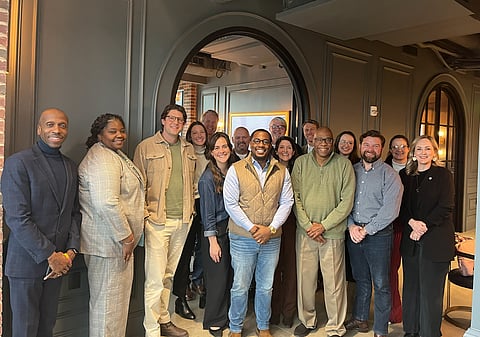
At the Human Flourishing Collective Impact Kickoff, Commissioner Clarence H. Carter of the Tennessee Department of Human Services addressed community leaders, nonprofit partners, faith organizations, and local officials, emphasizing the importance of shared vision and collaboration.
The gathering marked the beginning of a coordinated, cross-sector effort to better serve neighbors in crisis. Church of the City will serve as the backbone organization for the initiative, convening partners and supporting long-term systems change across the county.
The meeting was led by Will Acuff, coordinator for the Human Flourishing Initiative in Williamson County, who framed the work around a realization many in the room had already experienced.
“None of us can do this alone. No single organization, no single strategy, no single sector,” Acuff said. “The issues are too big, the problems are too interconnected, and the stakes are so high. Neighbors get left behind. Neighbors fall through the cracks.”
Acuff emphasized that the challenge has never been a lack of compassion or effort. The real challenge has been a lack of coordination and shared measurement. Human Flourishing seeks to address both.
The model is both technology-enabled and relationship-driven.
“One way to think about Human Flourishing is as a robust software platform that connects government services, nonprofit action, and faith communities,” Acuff explained. “But the real difference comes from full-time case managers who sit on top of that system and help connect the dots for neighbors.”
This approach reflects Governor Lee’s belief that while government can build structure and allocate resources, communities create belonging and transformation.
The Human Flourishing Initiative does not replace the work of state agencies. It strengthens it by creating a coordinated ecosystem where families experience clarity instead of confusion and connection instead of fragmentation.
The collaborative framework being implemented in Williamson County draws from the Restore Hope model, which has been used in communities across the country to align systems, leverage data, and move families from crisis toward long-term stability through coordinated care.
Families facing hardship rarely experience a single challenge. More often, they are navigating several systems at once.
I shared a simple illustration with the audience.
When your car stops working, you do not just need one specialist who handles a single issue. You need someone who can diagnose the entire vehicle from bumper to bumper, identify what is going wrong, and coordinate the right experts to work together so the car can run again.
The Human Flourishing Initiative seeks to create that kind of coordinated response.
The goal is a true community ecosystem where there is “no wrong door” for individuals and families seeking help. Whether someone first connects with a church, a nonprofit, or a government agency, that first point of contact should lead them into a broader network of care and support.
Commissioner Carter affirmed both the county’s commitment and the deeper moral urgency behind the initiative.
“It takes every sector of our society to solve this most vexing problem,” he said. “When we link arms in the shared purpose of lifting the most vulnerable, we demonstrate that every soul in Tennessee is redeemable. No matter how deep the challenge, people can grow beyond it.”
Commissioner Carter oversees programs that serve thousands of Tennesseans, with a focus on moving families from crisis toward long-term economic stability. His leadership reflects Tennessee’s broader commitment to modernizing systems, strengthening workforce pathways, and improving long-term outcomes.
The Williamson County kickoff marked more than a meeting. It marked a shift toward collective responsibility.
Through the Human Flourishing Initiative, the Governor’s Faith-Based and Community Initiative is helping build a Tennessee framework where public agencies and private compassion work side by side.
With more than 11,500 houses of worship and more than 30,000 socially engaged nonprofits across the state, the capacity for transformation already exists.
The Human Flourishing Initiative is about activating it.
Tennessee is choosing collaboration over silos, coordination over fragmentation, and dignity over dependency. It is a belief that sustainable change happens when systems work together and when neighbors take responsibility for one another.
Smart Justice is a magazine, podcast, and continuing news coverage from the nonprofit Restore Hope and covers the pursuit of better outcomes on justice system-related issues, such as child welfare, incarceration, and juvenile justice. Our coverage is solutions-oriented, focusing on the innovative ways in which communities are solving issues and the lessons that have been learned as a result of successes and challenges.
The podcast is available on all major podcasting platforms.
Subscribe to the Smart Justice newsletter.
