
- Home
- TopicsTopics
- By LocationBy Location
- Newsletter
- Podcast
- About
- Connect
- Restore Hope

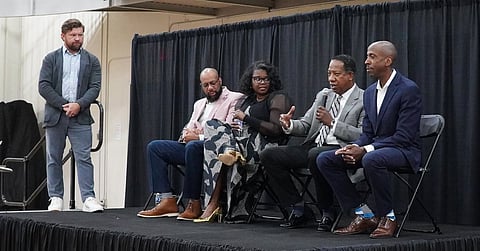
Tennessee leaders gathered in Memphis to deliver a consistent message: communities cannot solve complex social challenges by working in isolation.
The discussion, held during a community meeting introducing the Human Flourishing Initiative, featured leaders from the Tennessee Departments of Children's Services, Human Services, and Labor and Workforce Development. Together, they described why Tennessee is embracing a community-led model that is based on an approach to coordinated care originally developed by Restore Hope in Arkansas.
Rather than creating another program, they said, the Human Flourishing Initiative is designed to connect existing organizations so families can receive help through a single, coordinated system.
Gary Wilson, assistant commissioner with the Tennessee Department of Human Services, argued that the biggest challenge facing families isn't necessarily a lack of resources.
"The reality is that each and every one of you are out here doing great work," Wilson told the audience. "There's not a resource problem here. There's a structure problem that we must fix."
Wilson said organizations across Memphis are already serving thousands of people individually, but the Human Flourishing Initiative is intended to help them work together.
"Just think about that collective impact," he said.
After visiting Arkansas to observe Restore Hope's model firsthand, Wilson said what stood out was the way technology and collaboration eliminated duplication for families in crisis.
"Can you imagine that mother or that parent needing resources... and they have to go tell that story six different times just to get the resources that they need?" he asked.
"This model pulls all that together under one. It's a 'no wrong door' approach... that family can get what they need by telling that story one time and one time only."
For leaders with the Tennessee Department of Children's Services, the conversation centered on prevention. Deputy Commissioner Karen Bryant said the department's goal is to keep children safely with their families whenever possible.
"One of the many things that we're trying to do within the department is to build a system that puts children first, and do everything within our power to keep families intact," Bryant said.
Too often, she said, child welfare workers encounter families struggling with circumstances beyond their control.
"Families should not be punished because life is happening to them," Bryant said. "And if we can partner with our colleagues and other state agencies to prevent that from happening, then I'm here for it."
Bryant described the initiative as a major shift in child welfare.
"Primary prevention is new to our industry," she said. "This is truly transformational."
Assistant Commissioner DeShawn Harris echoed that message, emphasizing that families need coordinated support—not agencies working independently.
"We are learning across the country that in a family is the best place to raise a child," Harris said. "You do not want the state to raise your child."
He said the initiative will strengthen the resources available to families before crises escalate.
Bryant offered a strong assessment of why change is needed.
"I think one of the failures of child welfare here in Tennessee, and beyond, is we've tried to do it by ourselves."
"The reality is we can't. And unfortunately, because we've been trying to go at it alone, we've been failing children and families."
She said the Human Flourishing Initiative offers an opportunity for agencies and community organizations to finally align around families instead of operating separately.
"We owe it to the families that we're serving for us to get it together."
Deputy Commissioner DeWayne Scott of the Tennessee Department of Labor and Workforce Development emphasized that employment is one of the most important long-term outcomes for families.
"Work and a job does things for us," Scott said. "It provides economic benefit. But I would suggest even more so... the value, the worth, and the dignity that a job gives you."
Scott said the department wants to help individuals move beyond simply finding employment.
"With the Human Flourishing Initiative, we're talking about taking people from crisis to stability, and then from stability to thriving, and then thriving to flourishing."
He also stressed that the initiative is designed to be led by local communities.
"It's not the state leading the effort," Scott said. "The state comes alongside."
Wilson closed the discussion with a reminder that no single strategy will solve every challenge.
"We're dealing with human behavior," he said. "There is no silver bullet."
Instead, he described the Human Flourishing Initiative as a learning model focused on measuring well-being while continually improving.
Sharing part of his own story, Wilson recalled recovering from a serious injury after someone encouraged him during one of the most difficult seasons of his life.
"They looked at me and they said, 'Gary, if you lost your faith, I got enough of both of us. That one comment... gave me hope. Hope led to confidence. Confidence led to trying again."
Throughout the discussion, the panelists returned to one central idea: communities likely possess the people, organizations, and resources needed to help families. The challenge is bringing those partners together so that every family has a clear path from crisis to stability and, ultimately, to flourishing.
Related Stories:
Smart Justice is a magazine, podcast, and continuing news coverage from the nonprofit Restore Hope and covers the pursuit of better outcomes on justice system-related issues, such as child welfare, incarceration, and juvenile justice. Our coverage is solutions-oriented, focusing on the innovative ways in which communities are solving issues and the lessons that have been learned as a result of successes and challenges.
The podcast is available on all major podcasting platforms.
Subscribe to the Smart Justice newsletter.
